How to Practice for Job Interviews Alone (Methods That Actually Work)
The Problem With "Just Practice"
Everyone tells you to practice before an interview. Nobody tells you how to practice when you're sitting alone in your room with no one to ask you questions and no way to know if your answers are any good.
So most people don't practice at all. They read a list of common questions, mentally rehearse a few answers, and hope for the best. Then they walk into the interview and freeze on the first behavioral question.
Practicing alone is possible, and it works. You just need the right method.
Start With the Questions You'll Actually Get Asked
Before you practice anything, know what you're practicing for. Most interviews follow predictable patterns based on the role:
- Behavioral questions — "Tell me about a time when..." (almost every interview)
- Situational questions — "What would you do if..." (common for management and client-facing roles)
- Technical questions — specific to your field (engineering, finance, data, etc.)
- Competency questions — "How do you approach..." (common in structured interviews)
Look at the job description. What skills and qualities does it emphasize? Those are the topics your interviewer will ask about. If the posting mentions "cross-functional collaboration" three times, you're getting a question about teamwork.
The STAR Method: Your Answer Framework
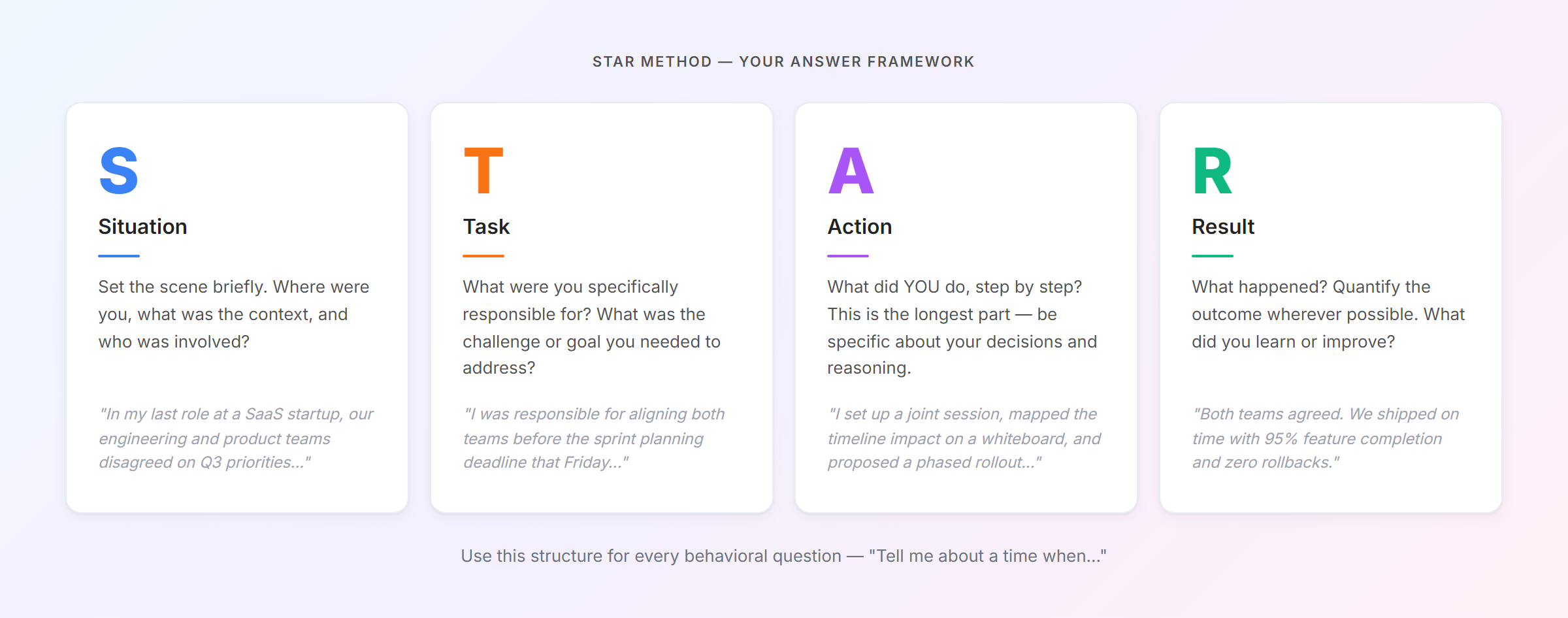
For behavioral and situational questions, the STAR method gives you a clear structure:
- Situation — Set the scene briefly. Where were you? What was the context?
- Task — What were you responsible for? What was the challenge?
- Action — What did you specifically do? (This is the longest part.)
- Result — What happened? Quantify if possible.
Here's the difference between a bad answer and a STAR answer:
Bad: "Yeah, I've dealt with difficult stakeholders before. I usually just try to communicate clearly and find common ground."
Good: "In my last role, our marketing team and engineering team disagreed on the priority of a product launch feature. I was responsible for aligning both teams. I set up a 30-minute meeting with both leads, mapped out the timeline impact of each option on a whiteboard, and proposed a phased approach that gave marketing their launch date while giving engineering an extra sprint for the complex feature. Both teams agreed, and we shipped on time with a 95% feature completion rate."
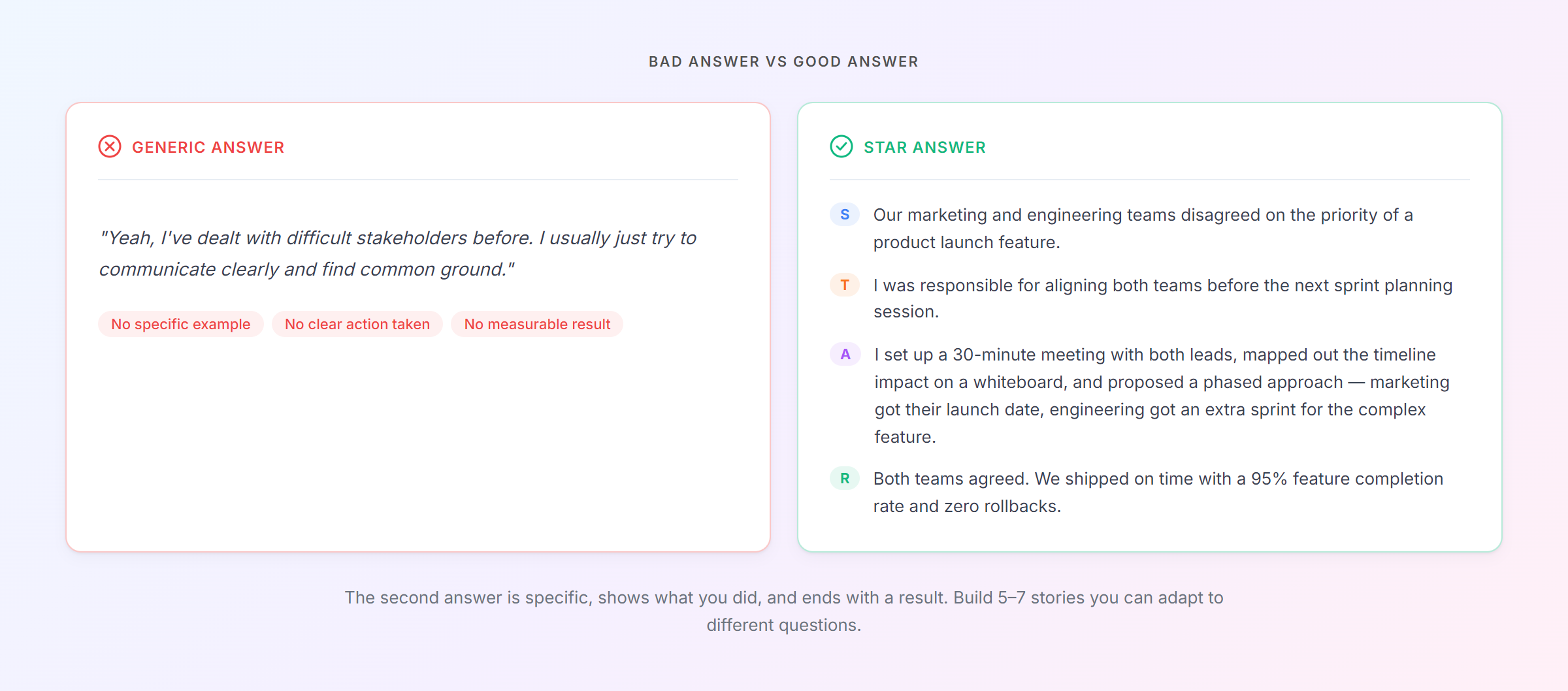
The second answer is specific, shows what you did, and ends with a result. Practice building these stories for 5-7 experiences you can adapt to different questions.
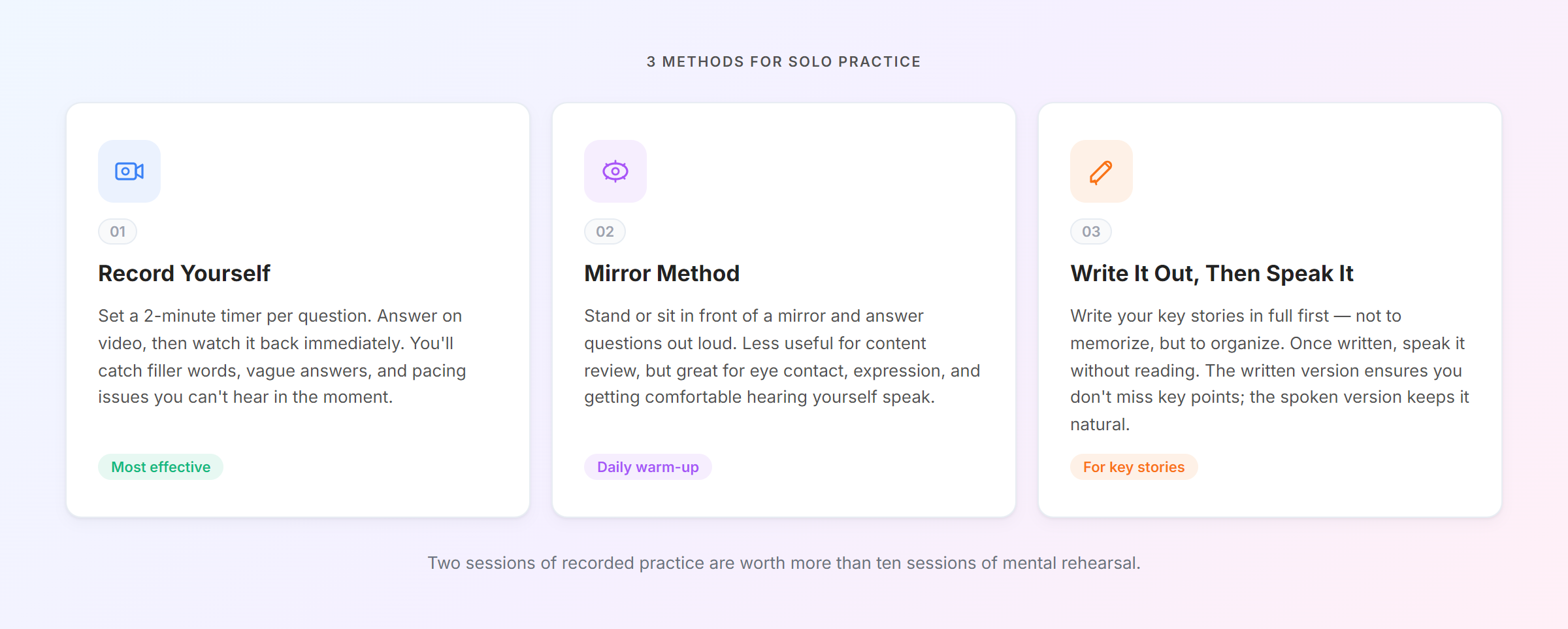
Method 1: Record Yourself Answering
This is the most effective solo practice method. Here's how:
- Pull up a list of common interview questions for your role
- Set a timer for 2 minutes per answer
- Record yourself on your phone (video, not just audio)
- Answer the question as if you're in a real interview
- Watch the recording immediately after
You'll notice things you can't catch in the moment — filler words ("um," "like," "you know"), rushed pacing, vague answers that don't include specific examples, fidgeting, or breaking eye contact with the camera.
It feels awkward. Do it anyway. Two sessions of recorded practice are worth more than ten sessions of mental rehearsal.
Method 2: The Mirror Method
Stand or sit in front of a mirror and answer questions out loud. This is less effective than recording (you can't review it later), but it helps with:
- Maintaining eye contact
- Controlling facial expressions
- Being aware of your posture and hand gestures
- Getting comfortable hearing yourself speak
Use this method for quick daily practice — 10 minutes in the morning answering one or two questions.
Method 3: Write It Out, Then Speak It
For your most important stories (the ones you'll use for "tell me about yourself," "your biggest achievement," and "your biggest challenge"), write the answer out in full. Not as a script to memorize, but as a way to organize your thoughts.
Once written, practice saying it out loud without reading. You'll naturally simplify the language and find a rhythm. The written version ensures you don't miss key points; the spoken version keeps it conversational.
Where Solo Practice Hits a Wall
These methods will get you 70% of the way there. But they all share one limitation: you don't get feedback.
When you practice alone, you can't tell if:
- Your answer actually addressed the question
- You spoke for too long or too short
- Your STAR story had enough detail in the Action section
- You used too much jargon for a non-technical interviewer
- Your tone sounded confident or nervous
This is why real mock interviews — with a friend, mentor, or career coach — are so valuable. They ask follow-up questions, push back on vague answers, and tell you what landed and what didn't.
But finding someone willing to sit through a 45-minute mock interview isn't always easy, especially if you're job searching privately.
AI Interview Practice: The Middle Ground
This is exactly why we built Jobbital's Interview Coach. It's a voice-based AI that conducts realistic practice interviews tailored to the specific job you're applying for.
You select a job from your applications, and the AI reads the job description and your CV. It asks relevant questions — behavioral, technical, situational — based on what the interviewer is likely to ask. You answer by speaking naturally, not typing.
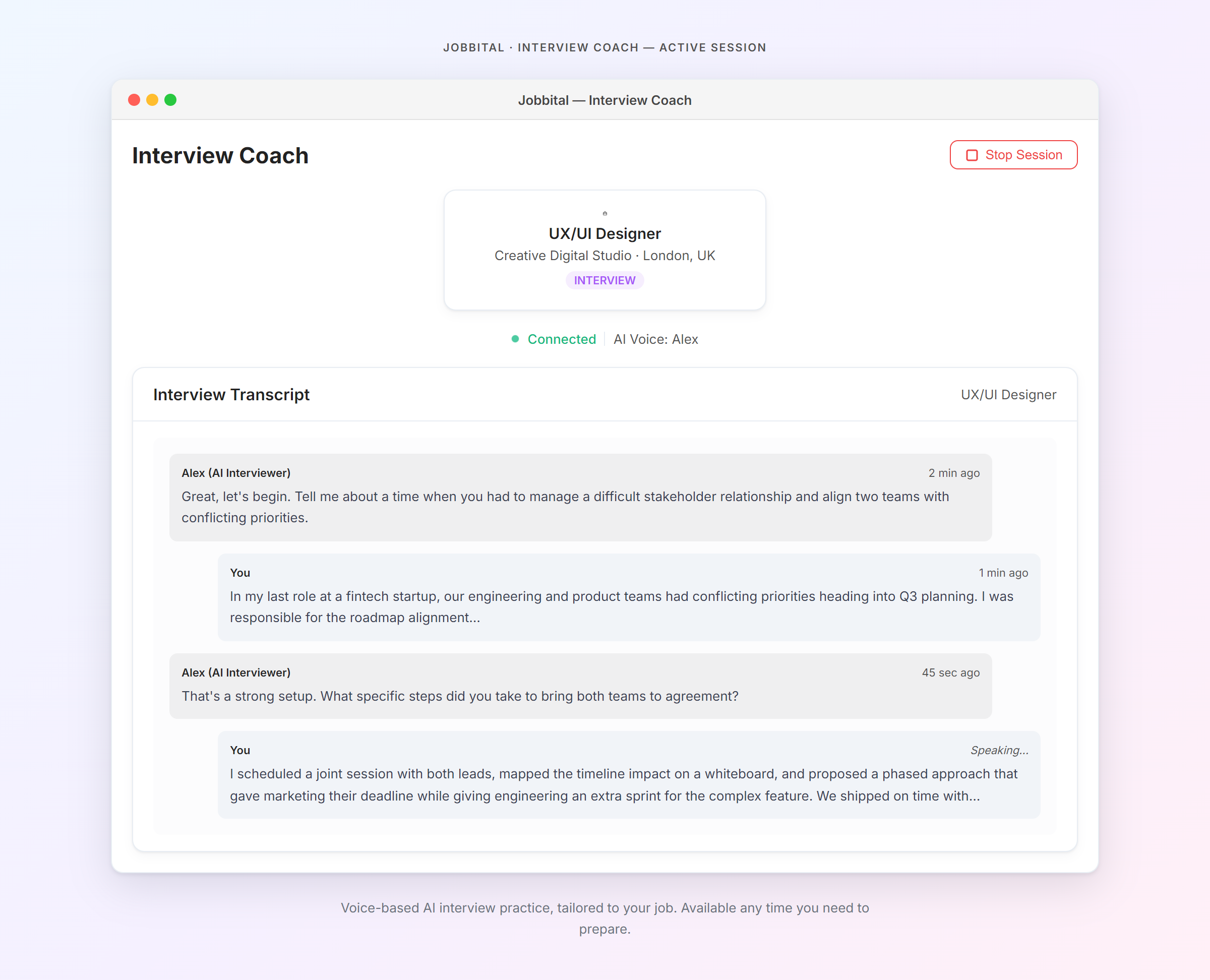
The AI adapts in real time: if your answer is vague, it asks a follow-up. If you're on the right track, it moves to the next topic. Every session is transcribed so you can review exactly what you said.
It works in 96+ languages, so if you're preparing for an interview in a second language, you can practice in that language specifically.
It's not a replacement for a real mock interview with a mentor. But it's available at midnight when you have an interview tomorrow morning, and it'll run through as many practice sessions as you need.
Tips for Better Interview Practice
Practice Your Opening
"Tell me about yourself" is almost always the first question. Have a 60-90 second answer ready. Practice it until it flows naturally. A strong opening sets the tone for the entire interview.
Time Your Answers
Most behavioral answers should be 1.5-2.5 minutes. Under a minute feels shallow. Over three minutes and you're losing the interviewer. Use a timer during practice.
Prepare for Follow-Ups
After every STAR answer, expect the interviewer to dig deeper: "What would you do differently?" "How did your manager respond?" "What did you learn from that?" Practice answering these without hesitation.
Practice the Awkward Questions Too
Don't just practice questions you're comfortable with. Practice the ones you dread: gaps in your resume, why you left your last job, a project that failed. Having a practiced, honest answer ready eliminates the panic.
Do a Full Run-Through
At least once before your actual interview, do a complete mock session: intro, 5-6 questions, and your closing questions for the interviewer. Practice the whole flow, not just isolated answers.
Try Jobbital's Interview Coach
See how Jobbital's Interview Coach can help — free to start.
No credit card required. Free plan available.